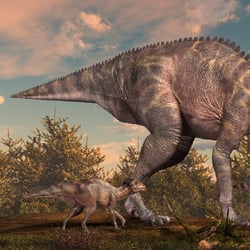
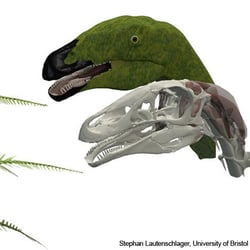
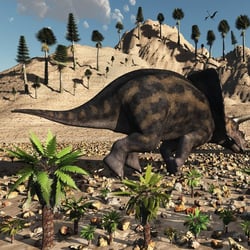
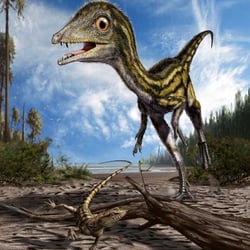
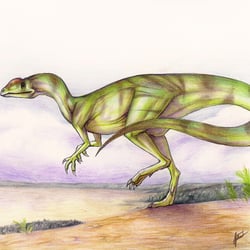
Echinodon was a herbivore. It lived in the Cretaceous period and inhabited Europe and North America. Its fossils have been found in places such as England (United Kingdom), Colorado and New Aquitaine (France).
Quick facts about Echinodon:
- Existed from Kimmeridgian Age to Berriasian Age
- Lived in a terrestrial habitat
- Was a herbivore
- Reproduced by laying eggs
- 5 different specimens have been found by paleontologists
All the Echinodon illustrations below were collected from the internet. Enjoy and explore:
- View Echinodon on ancient earth globe
- Random dinosaur
- More from the Cretaceous period
- More in Europe
- More in North America
- All dinosaurs
- Search:
Echinodon was described by the following scientific paper(s):
- D. Néraudeau, R. Allain, and M. Ballèvre, D. J. Batten, E. Buffetaut, J. P. Colin, M. P. Dabard, V. Daviero-Gomez, A. El Albani, B. Gomez, D. Grosheny, J. Le Loeuff, A. Leprince, C. Martín-Closas, E. Masure, J.-M. Mazin, M. Phillipe, J. Pouech, H. Tong, J. F. Tournepiche, R. Vullo. 2012. The Hautevarian–Barremian lignitic bone bed of Angeac (Charente, south-west France): stratigraphical, palaeobiological and palaeogeographical implications. Cretaceous Research 37(1):1-14
- K. F. Hirsch, R. G. Young, and H. J. Armstrong. 1987. Eggshell fragments from the Jurassic Morrison Formation of Colorado. In W. R. Averett (ed.), Paleontology and Geology of the Dinosaur Triangle: Guidebook for 1987 Field Trip. Museum of Western Colorado, Grand Junction
- P. C. Ensom. 1987. A remarkable new vertebrate site in the Purbeck Limestone Formation on the Isle of Purbeck. Proceedings of the Dorset Natural History and Archaeological Society 108:205-206